


Skip to Content
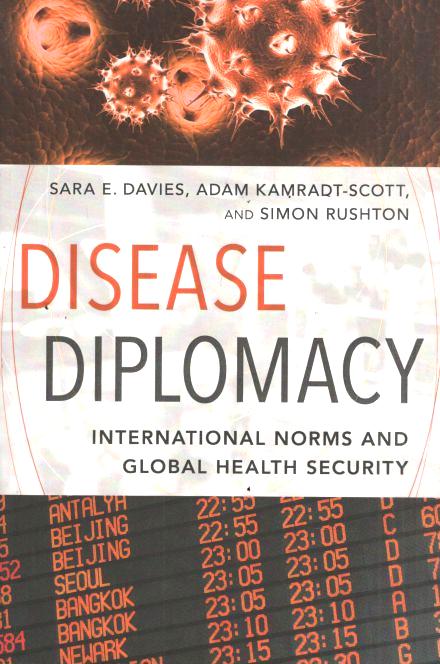
Disease Diplomacy : International Norms and Global Health Security

Price:

9,000.00 ৳


আত্মদর্শন
আত্মদর্শন
636.00 ৳
795.00 ৳ (20% OFF)
Dhaka From City to Megacity
1,196.00 ৳
1,495.00 ৳ (20% OFF)

Disease Diplomacy : International Norms and Global Health Security

In the age of air travel and globalized trade, pathogens that once took months or even years to spread beyond their regions of origin can now circumnavigate the globe in a matter of hours. Amid growing concerns about such epidemics as Ebola, SARS, MERS, and H1N1, disease diplomacy has emerged as a key foreign and security policy concern as countries work to collectively strengthen the global systems of disease surveillance and control._x000D_ _x000D_ The revision of the International Health Regulations (IHR), eventually adopted by the World Health Organization’s member states in 2005, was the foremost manifestation of this novel diplomacy. The new regulations heralded a profound shift in international norms surrounding global health security, significantly expanding what is expected of states in the face of public health emergencies and requiring them to improve their capacity to detect and contain outbreaks._x000D_ _x000D_ Drawing on Martha Finnemore and Kathryn Sikkink’s “norm life cycle” framework and based on extensive documentary analysis and key informant interviews, Disease Diplomacy traces the emergence of these new norms of global health security, the extent to which they have been internalized by states, and the political and technical constraints governments confront in attempting to comply with their new international obligations. The authors also examine in detail the background, drafting, adoption, and implementation of the IHR while arguing that the very existence of these regulations reveals an important new understanding: that infectious disease outbreaks and their management are critical to national and international security._x000D_ _x000D_ The book will be of great interest to academic researchers, postgraduate students, and advanced undergraduates in the fields of global public health, international relations, and public policy, as well as health professionals, diplomats, and practitioners with a professional interest in global health security.
See More
https://pathakshamabesh.com/web/image/product.template/50576/image_1920?unique=8969709

9,000.00 ৳ 9000.0 BDT 10,000.00 ৳

Not Available For Sale

(10% OFF)

This combination does not exist.

In the age of air travel and globalized trade, pathogens that once took months or even years to spread beyond their regions of origin can now circumnavigate the globe in a matter of hours. Amid growing concerns about such epidemics as Ebola, SARS, MERS, and H1N1, disease diplomacy has emerged as a key foreign and security policy concern as countries work to collectively strengthen the global systems of disease surveillance and control._x000D_ _x000D_ The revision of the International Health Regulations (IHR), eventually adopted by the World Health Organization’s member states in 2005, was the foremost manifestation of this novel diplomacy. The new regulations heralded a profound shift in international norms surrounding global health security, significantly expanding what is expected of states in the face of public health emergencies and requiring them to improve their capacity to detect and contain outbreaks._x000D_ _x000D_ Drawing on Martha Finnemore and Kathryn Sikkink’s “norm life cycle” framework and based on extensive documentary analysis and key informant interviews, Disease Diplomacy traces the emergence of these new norms of global health security, the extent to which they have been internalized by states, and the political and technical constraints governments confront in attempting to comply with their new international obligations. The authors also examine in detail the background, drafting, adoption, and implementation of the IHR while arguing that the very existence of these regulations reveals an important new understanding: that infectious disease outbreaks and their management are critical to national and international security._x000D_ _x000D_ The book will be of great interest to academic researchers, postgraduate students, and advanced undergraduates in the fields of global public health, international relations, and public policy, as well as health professionals, diplomats, and practitioners with a professional interest in global health security.


Title

Disease Diplomacy : International Norms and Global Health Security

Publisher

Johns Hopkins University Press

Number of Pages

178

Language

English (US)

Category

  • Health Care Managament / Public Health
  • First Published

    JAN 2015

    Delivery Charge (Based on Location & Book Weight)

     Inside Dhaka City: Starts from Tk. 70 (Based on book weight)

     Outside Dhaka (Anywhere in Bangladesh): Starts from Tk. 150 (Weight-wise calculation applies)

     International Delivery: Charges vary by country and book weight — will be informed after order confirmation.

     3 Days Happy ReturnChange of mind is not applicable

     Multiple Payment Methods

    Credit/Debit Card, bKash, Rocket, Nagad, and Cash on Delivery also available. 

    In the age of air travel and globalized trade, pathogens that once took months or even years to spread beyond their regions of origin can now circumnavigate the globe in a matter of hours. Amid growing concerns about such epidemics as Ebola, SARS, MERS, and H1N1, disease diplomacy has emerged as a key foreign and security policy concern as countries work to collectively strengthen the global systems of disease surveillance and control._x000D_ _x000D_ The revision of the International Health Regulations (IHR), eventually adopted by the World Health Organization’s member states in 2005, was the foremost manifestation of this novel diplomacy. The new regulations heralded a profound shift in international norms surrounding global health security, significantly expanding what is expected of states in the face of public health emergencies and requiring them to improve their capacity to detect and contain outbreaks._x000D_ _x000D_ Drawing on Martha Finnemore and Kathryn Sikkink’s “norm life cycle” framework and based on extensive documentary analysis and key informant interviews, Disease Diplomacy traces the emergence of these new norms of global health security, the extent to which they have been internalized by states, and the political and technical constraints governments confront in attempting to comply with their new international obligations. The authors also examine in detail the background, drafting, adoption, and implementation of the IHR while arguing that the very existence of these regulations reveals an important new understanding: that infectious disease outbreaks and their management are critical to national and international security._x000D_ _x000D_ The book will be of great interest to academic researchers, postgraduate students, and advanced undergraduates in the fields of global public health, international relations, and public policy, as well as health professionals, diplomats, and practitioners with a professional interest in global health security.

    No Specifications